
Equity indices frittered away a good start to close with modest losses on Monday, pressured by heavy selling in metal stocks after the government imposed export duties on steel-making raw materials to curb soaring prices. The 30-share BSE Sensex opened strong and gained momentum as the session progressed, but came under severe selling pressure in afternoon trade to close 37.78 points or 0.07 per cent lower at 54,288.61. On similar lines, the broader NSE Nifty slipped 51.45 points or 0.32 per cent to end at 16,214.70.

The government on Thursday allowed free inter-state wheeling of renewable energy used in the production of green hydrogen and ammonia as it seeks to boost usage of the carbon-free fuel and make India an export hub. Unveiling the first part of the much-awaited National Hydrogen Policy, Power and New and Renewable Energy Minister Raj Kumar Singh said the government is targeting production of 5 million tonnes of green hydrogen by 2030. Oil refineries to steel plants require hydrogen to produce finished products.

UltraTech Cement was the top gainer in the Sensex pack, rising 3.06 per cent, followed by IndusInd Bank, ICICI Bank, HDFC Bank, Titan, Axis Bank, SBI and Reliance Industries. NSE Nifty advanced 78.35 pointsto close at 14,814.75.
ONGC was the top loser in the Sensex pack, shedding 4 per cent, followed by Bharti Airtel, SBI, IndusInd Bank, NTPC, Sun Pharma and ITC. On the other hand, Bajaj Finance, Bajaj Auto, Reliance, Bajaj Finserv and Asian Paints were among the gainers.

In order to determine whether this would be sound strategy for them, one needs to look at two issues: One, on the alliances being built globally between telcos, on one hand, and cloud service firms, on the other, especially with the advent of 5G; and two, how their business strategies in India will blend into with such a deal.

So which sectors are likely to do well in 2022? Should you focus on domestic economy-related sectors or export-oriented ones?

It's hard to say because of the winner-take-all nature of new platform and network businesses, but Reliance has not been an efficient user of capital, and Adani numbers are varied, observes T N Ninan.

Dr Reddy's was the top gainer in the Sensex pack, rising over 3 per cent, followed by PowerGrid, TCS, HCL Tech, Infosys and Reliance Industries. On the other hand, L&T, IndusInd Bank, Bajaj Finserv and Bharti Airtel were among the laggards.

Relations between an elected government of Delhi and the LG can never be cordial: It is just the way the relationship is structured.
Bajaj Finance was the top loser, tumbling 4.68 per cent, followed by Tech Mahindra, IndusInd Bank, ICICI Bank, SBI, Reliance Industries, Bharti Airtel and HCL Tech. NSE Nifty crashed 290.70 points or 2.43 per cent to 11,680.35.

Equity indices failed to hold on to their gains in see-saw trade on Tuesday, ending in the red for the third straight session despite a tentative recovery in global equities. The rupee too bounced back from historic lows, but the overall sentiment remained risk-averse amid concerns over economic recovery in a high interest rate scenario. The 30-share BSE Sensex had a choppy start but gained momentum in mid-session trade. However, it succumbed to selling pressure towards the fag end to close 105.82 points or 0.19 per cent lower at 54,364.85. On similar lines, the broader NSE Nifty declined 61.80 points or 0.38 per cent to finish at 16,240.05.

Bharti Airtel was the top gainer in the Sensex pack, rising around 4 per cent, followed by Tech Mahindra, HDFC, Kotak Bank, M&M and HCL Tech. NSE Nifty advanced 21.85 points to 16,280.10.

The Tata group is looking to make a foray into semiconductor (also known as chips) manufacturing and it has set up a business to seize the opportunity, Chairman N Chandrasekaran said on Monday. "At the Tata group, we have already pivoted into a number of new businesses like electronics manufacturing, 5G network equipment as well as semiconductors, in all probability," he said while speaking at the annual general meeting of the IMC Chamber of Commerce and Industry. Chandrasekaran said global supply chains, currently heavily dependent on China, would see a big change in a post-pandemic world with businesses shifting their reliance to other countries.

IndusInd Bank, Kotak Bank, ICICI Bank, Sun Pharma, Bajaj Finance and Ultratech Cement were prominent gainers. NSE Nifty rose 176.65 points to 14,867.35.

Kotak Bank was the top loser in the Sensex pack, shedding over 2 per cent, followed by ICICI Bank, PowerGrid, HDFC, IndusInd Bank and Axis Bank. NSE Nifty declined 45.75 points to 16,568.85.

'When a Project Director is appointed, the whole organization -- including the Chairman ISRO -- works for his success. It is a lesson that has been of abiding value all through the other projects I have worked on,' recalls the late President, one of the earliest pioneers at ISRO.

Reliance Industries Ltd's focus on the next hypergrowth opportunities in clean tech and its path to decarbonisation has the potential to spur re-rating, raises clarity on investment cycles and reduces investor worry, brokerages said. RIL chairman Mukesh Ambani at the company's 'Green AGM' on Thursday committed Rs 75,000 crore over the next three years to set up an integrated Green Energy Giga Complex across 5,000 acres in Jamnagar, Gujarat which will contain four giga factories. The complex, which would be one of the world's largest renewable manufacturing facilities, would have an integrated solar photovoltaic module factory, an energy storage battery factory, electrolyser manufacturing for hydrogen production, and manufacturing of fuel cells so that hydrogen can be used in transportation.

Benchmark stock indices Sensex and Nifty tumbled nearly 1 per cent on Wednesday due to profit booking in banking, financial and IT stocks after a recent rally. The 30-share BSE Sensex plunged 537.22 points or 0.94 per cent to end at 56,819.39 as 24 of its stocks declined. During the day, it tanked 772.57 points or 1.34 per cent to touch a low of 56,584.04. The broader NSE Nifty declined by 162.40 points or 0.94 per cent to 17,038.40 with 39 of its constituents ending in the red. Bajaj Finance was the biggest loser among Sensex stocks, dropping by 7.24 per cent.

NTPC was the biggest loser in the Sensex pack, tumbling 2.25 per cent, followed by Tata Motors, Bharti Airtel, PowerGrid, HDFC, Reliance Industries, Hero MotoCorp and M&M that shed up to 1.85 per cent.

If an elected government had been sworn in, Jung's tenure and the government would have been more or less co-terminus and Jung would have been just the ceremonial head of Delhi. Now, he will run Delhi, pending another round of assembly elections, says Aditi Phadnis

Recently, world headlines buzzed with Elon Musk's announcement that he was shelving his audacious bid for social media platform Twitter. Away from the media spotlight, questions are being asked about the maverick billionaire's plans in India, too. A few days ago, a Reuters report said Musk's flagship Tesla had put on hold its plan to launch electric cars in India.

General Pande said the northern border region has been peaceful and steps have been taken to maintain peace through established protocol and existing mechanism.

Finance Minister Nirmala Sitharaman on Tuesday unveiled a Rs 39.45 lakh crore Budget with a view to fire up the key engines of the economy to sustain a world-beating recovery from the pandemic. This was Sitharaman's fourth Budget. While the taxpayers were left in the lurch, once again, was she able to cheer Corporate India?

TCS was the top gainer in the Sensex pack, rising around 4 per cent, followed by ONGC, ICICI Bank, HDFC Bank, Dr Reddy's, HDFC and HCL Tech. NSE Nifty advanced 76.65 points to 14,581.45.

Both India and China talk now of self-reliance when their external trade, in relation to GDP, has been falling for some years, points out T N Ninan.

A weaker rupee could aid corporate earnings through its positive impact on export intensive sectors such as information technology services, pharmaceuticals and commodity producers such as metal and mining, and oil and gas companies.

Though most analysts expect the global central banks to keep the liquidity tap open, valuations of Indian markets, they say, are beginning to look stretched. Against this backdrop, they remain cautious, with some even expecting a minor correction from here on.
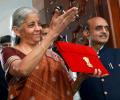
'The term 'pro-growth' must be qualified somewhat because, while a rising tide will lift all boats, it will not necessarily do so equally.'
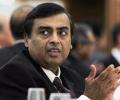
Reliance announced energy asset sales worth around $ 16 billion; end of the investment cycle in telecom; bringing net-debt to zero in 18 months; value-unlocking options for real estate and financial assets; listing of telecom and retail in five years; and focus on dividends.

Ambani is also the year's biggest gainer, adding USD 9.3 billion to his wealth amid the continuing success of his Reliance Jio broadband telco service.
SBI was the top gainer in the Sensex pack, jumping around 3 per cent, followed by Kotak Bank, Axis Bank, Bajaj Auto, Tech Mahindra, UltraTech Cement and PowerGrid. NSE Nifty rose 36.40 points to 15,337.85.
Despite unprecedented levels of uncertainty in Samvat 2077, investors have little to complain about on the returns front. The BSE Sensex delivered returns of 38 per cent in this period, while the Nifty registered a return of over 40 per cent. As is the case in bull markets, companies in the small- and mid-capitalisation basket outperformed the benchmarks, with returns almost twice those of frontliners.

India's goal of self-reliance has been paramount in the policy and practice of the country. The COVID-19 crisis gave us lessons on how to speed up efforts in that direction, he said.

L&T was the top loser in the Sensex pack, dropping 4.99 per cent, after the engineering major posted a 45 per cent decline in consolidated net profit for the September quarter. Titan, ONGC, Axis Bank, HUL, NTPC, M&M and HDFC were the other major laggards, shedding up to 3.32 per cent. NSE Nifty fell 58.80 points or 0.50 per cent to 11,670.80.

Though India was under lockdown for only seven days of the quarter, global demand and commodity prices began falling from February as COVID-19 was spreading in other countries. 1,002 listed companies - excluding banks, non-bank lenders, insurers, brokerages, and IT firms - reported a combined pre-tax loss of around Rs 2,700 crore during Q4.

Stock specific action is seen with some of the prominent companies posting their quarterly numbers.

This measure will ensure that the price of a scrip cannot move upward or downward beyond a limit set for the day.

Unlike the race to buy airwaves by telecom companies, airports by infrastructure companies and city gas networks by energy companies, the race to develop super apps by consumer-facing companies in India has not brushed up against any regulatory issues. Officials at the ministry of electronics and information technology and at other regulators are happy they do not have to meddle in who among the Tata group, Reliance Industries Ltd, Flipkart or Paytm will manage to build an app that sweeps in customers. Unlike separate apps a customer uses on her mobile to order groceries, buy food or airline tickets or just make payments, a super app can perform all these functions.
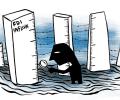
Foreign Direct Investment into India rose by 13 per cent in 2020, boosted by interest in the digital sector, and while fund flows "declined most strongly" in major economies such as the UK, the US and Russia due to the Covid-19 pandemic, India and China "bucked the trend", the UN has said.

In its report 'Global Top Picks', Barclays expects the current bull market in global equities to continue, generating a total return of 9 per cent in 2015.
